> For the complete documentation index, see [llms.txt](https://help.stockcharts.com/llms.txt). Markdown versions of documentation pages are available by appending `.md` to page URLs; this page is available as [Markdown](https://help.stockcharts.com/learning-more/step-by-step-instructions/sharpcharts-how-tos/sharpchart-editing-how-tos/how-to-add-an-overlay-to-an-indicator.md).
# How to Add an Overlay to an Indicator
It can be helpful to add an overlay, such as a moving average or Bollinger Bands, to an indicator panel on your chart. These overlays are often used with price indicators (in the same way they are used on the main price plot of the chart), but they can also be used with other indicators to smooth out indicator values or show indicator values falling outside typical ranges.
{% hint style="info" %}
**Learn More:** [Overlays](/charts-and-tools/sharpcharts/sharpcharts-workbench/editing-sharpcharts.md#adding_overlays) | [Indicators](/charts-and-tools/sharpcharts/sharpcharts-workbench/editing-sharpcharts.md#adding_indicators)
{% endhint %}
This in-depth tutorial walks you step-by-step through adding a SCTR indicator with a 20-day moving average of those SCTR values to a SharpChart.
## Tutorial: Adding a Moving Average to a SCTR Indicator
In this step-by-step tutorial, we'll add a SCTR indicator panel to the chart, and then add a 20-day simple moving average to the SCTR indicator to smooth out the SCTR values.
### Create the SharpChart
#### Step 1: Enter the Ticker Symbol
There are several ways to create a new SharpChart, but the easiest is to enter the symbol in the Create-a-Chart box at the top of the page and then click Go.
#### Step 2: Clear Indicators and Overlays
To simplify the chart, let's remove any Indicators and Overlays from the default chart. The quickest way to do that is to click the Clear All link in the Overlays section and repeat the process with the Clear All link in the Indicators section.
{% hint style="warning" %}
**Note:** You may want to make other changes to the chart, such as changing the size or the color scheme. In this example, we're using the “Spruce” color scheme.
{% endhint %}
### Add and Configure the SCTR Indicator
Before you can add an overlay to an indicator on your chart, you've got to add the indicator. Here we'll add a SCTR indicator panel at the bottom of the chart.
#### Step 3: Add SCTR Indicator to the Chart
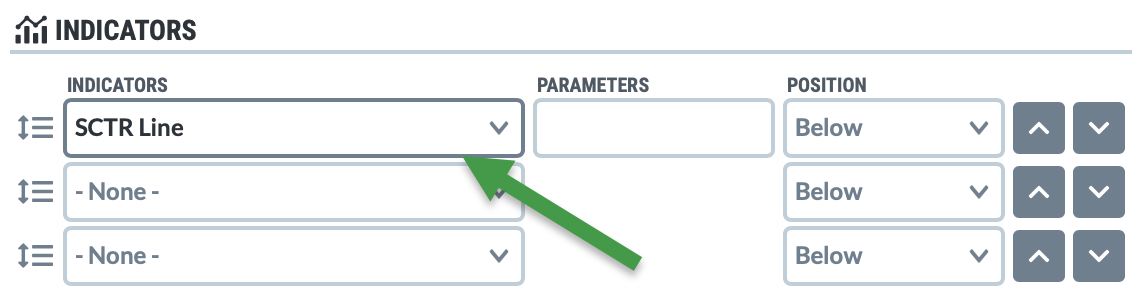
Select SCTR Line from one of the empty indicator dropdowns. This will add an indicator panel to the chart showing historical SCTR values for the chart's symbol. As with other indicators, you can change the position of the indicator panel using the Position dropdown menu.
Once these changes have been made, your chart should look similar to the one below.
#### Step 4: Add a Moving Average Overlay to the SCTR Indicator
In the Indicators section, click the "Overlay" dropdown menu for your SCTR Line, and select Simple Moving Average. By default, it is configured for a 50-day SMA, but you can change this in the Parameters box next to the Overlays dropdown menu. We'll change it to a 20-day SMA.
For more details about the available parameters for each overlay, please see our [SharpCharts Parameter Reference](/charts-and-tools/sharpcharts/sharpcharts-workbench/editing-sharpcharts/sharpcharts-parameter-reference.md).
Once you've made these changes, the final chart should look something like this:
The moving average applied to the indicator panel smooths out the choppy SCTR values.
---
# Agent Instructions
This documentation is published with GitBook. GitBook is the documentation platform designed so that both humans and AI agents can read, navigate, and reason over technical content effectively. Learn more at gitbook.com.
## Querying This Documentation
If you need additional information that is not directly available in this page, you can query the documentation dynamically by asking a question.
Perform an HTTP GET request on the following URL with the `ask` and `goal` query parameters:
```
GET https://help.stockcharts.com/learning-more/step-by-step-instructions/sharpcharts-how-tos/sharpchart-editing-how-tos/how-to-add-an-overlay-to-an-indicator.md?ask=&goal=
```
`ask` is the immediate question: it should be specific, self-contained, and written in natural language.
`goal` is what the user is ultimately trying to achieve, the reason they need the answer. Sharing it helps GitBook give you a better, more relevant answer. A goal is most helpful when it describes the outcome the user wants rather than restating the question. For example, with `ask=how do I create an API token`, a goal like `build a script that syncs our docs to a CMS` lets GitBook tailor the answer to that use case.
The response will contain a direct answer to the question and relevant excerpts and sources from the documentation.
Use this mechanism when the answer is not explicitly present in the current page, you need clarification or additional context, or you want to retrieve related documentation sections.